
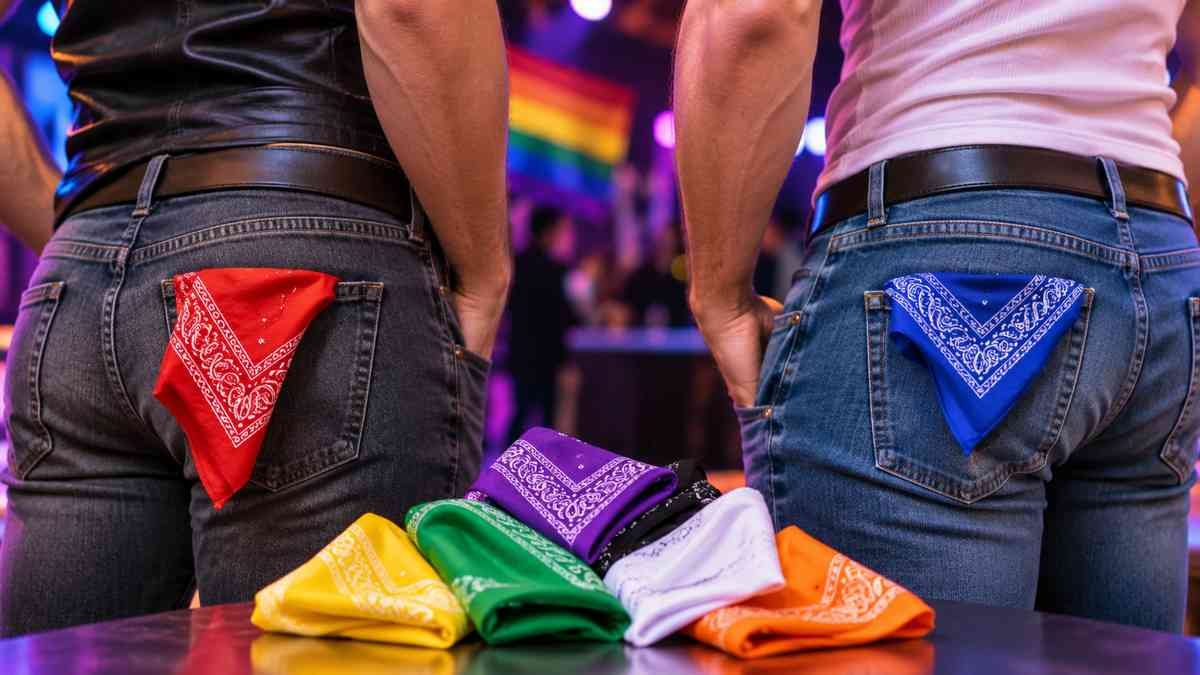
A handkerchief might seem like an ordinary fashion accessory, but in certain LGBTQ+ communities, it can communicate something much more personal. A particular colour tucked into a back pocket may signal an interest, preference, or role without requiring someone to say it out loud.
This tradition is known as the Hanky Code, also called the Handkerchief Code or Flagging. It became especially associated with gay male and leather communities, where it offered a discreet way to communicate sexual interests and find people with similar preferences.
Although dating apps and more open conversations have changed how people meet and express themselves, the Hanky Code remains an interesting part of LGBTQ+ history and culture.
So, what do the different colours mean? Does the left or right pocket matter? And is anyone still using the code today?
Let’s explore its history, traditional meanings, and modern-day relevance.
What Is the Hanky Code?
The Hanky Code is a system of nonverbal communication in which someone wears a coloured handkerchief, usually in a back pocket, to indicate a particular sexual interest, preference, or role.
Traditionally, the colour communicated the type of interest, while the pocket position could indicate whether someone preferred a particular role within that activity.
For example, a person might wear a light blue handkerchief to signal an interest in oral sex. Someone wearing it in the left pocket could traditionally be communicating a different role from someone wearing it in the right pocket.
The system became particularly associated with gay men in the United States during the 1970s and 1980s. It allowed people to communicate in social environments where openly discussing sexuality could be uncomfortable or risky.
The code was never a universal language, though. Meanings could vary between communities, locations, and individuals.
Where Did the Handkerchief Code Come From?
The precise origins of the Hanky Code are not fully established. Several historical explanations have been suggested, but not all are supported by reliable evidence.
One commonly repeated theory connects the tradition to nineteenth-century social dancing in San Francisco. According to this account, men sometimes wore coloured bandanas to distinguish dancing roles when women were less available.
However, the modern Hanky Code is most strongly associated with the gay leather and nightlife scenes of the 1970s.
During that period, openly discussing sexual preferences was not always easy. Social stigma, discrimination, and legal restrictions made discreet communication particularly useful.
A coloured handkerchief offered a simple visual signal. People who understood the code could recognise an interest without requiring an awkward or potentially uncomfortable conversation.
As the practice spread, more colours and meanings appeared. What began as a relatively simple signalling system developed into a much larger collection of community-specific interpretations.
How Does the Hanky Code Work?
Traditionally, the system uses two main elements:
- The colour: Indicates a particular sexual interest or activity.
- The pocket: Traditionally suggests a preferred role or position.
The handkerchief is usually worn in a back pocket, although people may use other visible placements depending on personal style and local customs.
What Does the Left Pocket Mean?
In the traditional interpretation, wearing a handkerchief in the left back pocket generally indicates a preference for the active, dominant, or giving role associated with the activity.
What Does the Right Pocket Mean?
The right back pocket traditionally indicates a preference for the receptive, submissive, or receiving role.
These interpretations are commonly associated with the historical code, but they are not universal rules. Some people reverse them, use different conventions, or do not attach any role-related meaning to pocket placement.
The important thing is not to assume that everyone follows the same system.
Hanky Code Colours and Their Traditional Meanings
The colour is the most recognisable part of the Hanky Code. Different colours became associated with different sexual interests, fetishes, or activities.
Here are some commonly documented traditional interpretations.
| Handkerchief colour | Traditional meaning |
| Red | Fisting |
| Orange | Anything goes |
| Yellow | Watersports |
| Green | Escorting or commercial sex |
| Light blue | Oral sex |
| Dark blue | Anal sex |
| Purple | Piercing |
| Grey | Bondage |
| Black | S&M or sadomasochism |
| Brown | Scat play |
These are historical associations, not a universal or officially standardised colour chart. The same colour can have different interpretations in different communities.
1. Red: Fisting
Red is traditionally associated with fisting, a sexual activity involving the insertion of a hand into the vagina or anus.
The colour became one of the recognisable signals within traditional versions of the code.
2. Orange: Anything Goes
Orange is commonly associated with openness to a broad range of sexual activities.
It can suggest that someone is flexible or interested in exploring different experiences, rather than signalling one specific activity.
3. Yellow: Watersports
Yellow traditionally indicates an interest in watersports, a term used for sexual activities involving urine.
It is one of the more distinctive associations in the traditional colour system.
4. Green: Escorting
Green has historically been associated with escorting or commercial sexual services.
Its meaning is different from colours that indicate a particular sexual activity or fetish.
5. Light Blue: Oral Sex
Light blue is traditionally associated with oral sex.
It is among the better-known Hanky Code colours and is often included in basic explanations of the system.
6. Dark Blue: Anal Sex
Dark blue traditionally signals an interest in anal sex.
The distinction between light blue and dark blue is important because they are associated with different activities.
7. Purple: Piercing
Purple is traditionally associated with piercing-related sexual interests.
As with other colours, its interpretation can depend on the community using the code.
8. Grey: Bondage
Grey is commonly associated with bondage, which involves consensual restraint as part of sexual or intimate activity.
The colour can signal an interest in restraint-related experiences without explaining someone’s exact boundaries or preferences.
9. Black: S&M
Black traditionally represents sadomasochism, often shortened to S&M.
This refers to consensual activities involving elements of sensation, dominance, submission, or pain.
10. Brown: Scat Play
Brown is traditionally associated with scat play, which involves sexual interest in faeces.
It is one of the more unusual and less commonly discussed entries in the traditional colour list.
Are There More Hanky Code Colours?
Yes. The traditional rainbow-colour list is only part of the broader system.
Over time, additional colours and variations appeared to communicate more specific interests and preferences. Some historical lists include colours associated with particular body types, fetish clothing, or specialised activities.
A few examples found in expanded versions of the code include:
- Apricot: Sometimes associated with chubby chasers.
- Beige: Sometimes associated with rimming.
- Dark pink: Sometimes associated with nipple or breast-related play.
- Charcoal: Sometimes associated with rubber or latex interests.
These meanings should be treated as examples from expanded interpretations, not as a definitive international standard.
There is no single authoritative list covering every colour and variation. Different historical charts may disagree, and newer interpretations may exist within particular communities.
Does the Side of the Handkerchief Really Matter?
Traditionally, yes. Pocket placement was an important part of the code.
The left-versus-right distinction was generally used to communicate whether someone preferred the active or receptive role associated with the activity.
For example, two people could wear the same colour but place it in different pockets to communicate different preferences.
However, there are important limitations:
- Not everyone follows the traditional pocket convention.
- Some people wear handkerchiefs simply as accessories.
- Different communities may interpret the positions differently.
- Someone may not use a fixed role or may prefer different roles depending on the situation.
A handkerchief can be a conversation starter, but it cannot tell you everything about another person’s preferences.
Is the Hanky Code Still Used Today?
Yes, although it is much less central to everyday dating than it once was.
Dating apps, LGBTQ+ social networks, and online communities have made it easier for people to discuss their interests and find others with similar preferences.
Instead of relying on a coloured handkerchief, someone can now describe their interests directly through a dating profile or private conversation.
However, the Hanky Code has not disappeared completely.
It still appears in some leather bars, LGBTQ+ events, fetish communities, and queer cultural spaces. Some people wear coloured handkerchiefs because they enjoy the tradition, while others use them as a playful way to reference LGBTQ+ history.
For some, the code is practical. For others, it is fashion, nostalgia, community identity, or simply a way to start a conversation.
Is the Hanky Code Only for Gay Men?
The Hanky Code is historically associated most strongly with gay men, particularly those involved in leather and fetish communities.
However, its use and interpretation are not necessarily limited to gay men.
People of different sexual orientations and gender identities may engage with the tradition, and some modern interpretations have expanded beyond the original conventions.
It is important to recognise its historical roots without assuming that every person who wears a coloured handkerchief identifies in the same way.
The code describes signals and cultural associations, not someone’s complete sexual identity.
Is the Hanky Code the Same Everywhere?
No. This is one of the most important things to understand.
Although certain colours have widely recognised traditional meanings, there is no universally enforced colour dictionary.
Meanings may differ according to:
- Country or region.
- Local LGBTQ+ communities.
- Leather and fetish subcultures.
- Historical period.
- Individual interpretation.
A colour that communicates one interest in a particular setting might mean something different somewhere else.
This is why it is risky to interpret a handkerchief without understanding the context.
If you are unsure what someone means, asking politely is much more reliable than assuming you have decoded their preferences.
What Is Flagging in LGBTQ+ Culture?
Flagging is the practice of using clothing, accessories, or other visual signals to communicate identity, interests, or preferences.
The Hanky Code is one of the best-known examples of flagging in gay male culture.
The term is closely connected to the use of coloured handkerchiefs, but the broader idea of flagging can include other visual signals and accessories.
Historically, these signals were useful because people did not always have the freedom or safety to discuss their sexuality openly.
Today, flagging can serve different purposes. Some people use it to connect with others who share their interests, while others appreciate it as an expression of cultural history.
Can You Wear a Handkerchief Without Using the Code?
Absolutely.
A coloured handkerchief is not automatically a sexual signal. People wear bandanas and handkerchiefs for fashion, personal style, cultural expression, and practical reasons.
Even in LGBTQ+ spaces, not everyone who wears one is participating in the Hanky Code.
Likewise, someone who understands the code may choose not to use it.
The meaning depends on context, intention, and whether the person is actually using the traditional signalling system.
Does Wearing a Certain Colour Mean Someone Consents to Sex?
No. This distinction is essential.
Even if someone deliberately wears a handkerchief to communicate a sexual interest, it does not mean they have agreed to participate in any activity.
A signal is not consent.
It does not automatically establish that someone wants to engage with a particular person, try a specific activity, or proceed beyond a conversation.
Consent must be communicated clearly, voluntarily, and continuously. People can change their minds or establish boundaries at any point.
The Hanky Code can help people express interests, but it cannot replace direct communication.
Frequently Asked Questions
1. What does the Hanky Code mean?
The Hanky Code is a traditional system of nonverbal communication in which coloured handkerchiefs signal particular sexual interests, preferences, or roles. It is historically associated with gay male and leather communities.
2. What is the difference between the Hanky Code and the Handkerchief Code?
There is no meaningful difference. Hanky Code and Handkerchief Code are two names for the same traditional signalling system.
3. What does a red handkerchief mean?
In traditional versions of the code, red is associated with fisting. However, interpretations can vary between communities.
4. What does a light blue handkerchief mean?
Light blue traditionally represents oral sex. It is one of the most commonly recognised colours in the Hanky Code.
5. What does a black handkerchief mean?
Black is traditionally associated with S&M, or sadomasochism, within the Hanky Code.
6. What does wearing a handkerchief in the right pocket mean?
Traditionally, the right back pocket indicates a receptive or submissive preference, while the left indicates an active or dominant preference. Not everyone follows this convention.
7. Is the Hanky Code still used?
Yes, some people still use it in leather bars, fetish communities, LGBTQ+ events, and other queer social spaces. However, dating apps and direct communication have reduced its everyday importance.
8. Is the Hanky Code only used by gay men?
It is historically associated with gay men, but people of different sexual orientations and gender identities may also use or appreciate the tradition.
9. Are Hanky Code colours universal?
No. The traditional colour associations are widely recognised in some communities, but meanings can vary by location, subculture, and individual interpretation.
10. Does wearing a coloured handkerchief mean someone wants sex?
Not necessarily. Someone might wear a handkerchief for fashion or cultural reasons. Even when it is being used as a signal, it does not imply consent or an invitation to engage in sexual activity.
The Hanky Code Is More Than a Collection of Colours
The Hanky Code is an interesting example of how people have found creative ways to communicate when openly expressing their sexuality was difficult.
What began as a discreet signalling tradition became part of gay leather culture and LGBTQ+ history. Its colours and pocket positions offered a way to communicate interests without always needing to say them out loud.
Today, its role has changed. Some people still use it, some wear handkerchiefs as fashion statements, and others appreciate the tradition for its historical significance.
Whether you encounter it at a queer event, in a leather bar, or while exploring LGBTQ+ culture, remember that the code is not universal. A coloured handkerchief may offer a clue, but an honest conversation is always the better way to understand what someone actually means.

Dating & Relationship Writer
Years of Experience: 10+.
Location: Sydney, Australia
Sophie Bennett writes about dating, love, relationship challenges, and emotional well-being. Her articles cover topics such as understanding mixed signals, recognising unhealthy relationship patterns, improving communication, and building stronger romantic connections.
With a warm and practical writing style, Sophie aims to make relationship topics easier to understand and relatable to everyday life. Her goal is to help readers navigate modern dating, understand their feelings, and approach relationships with greater clarity and confidence.